

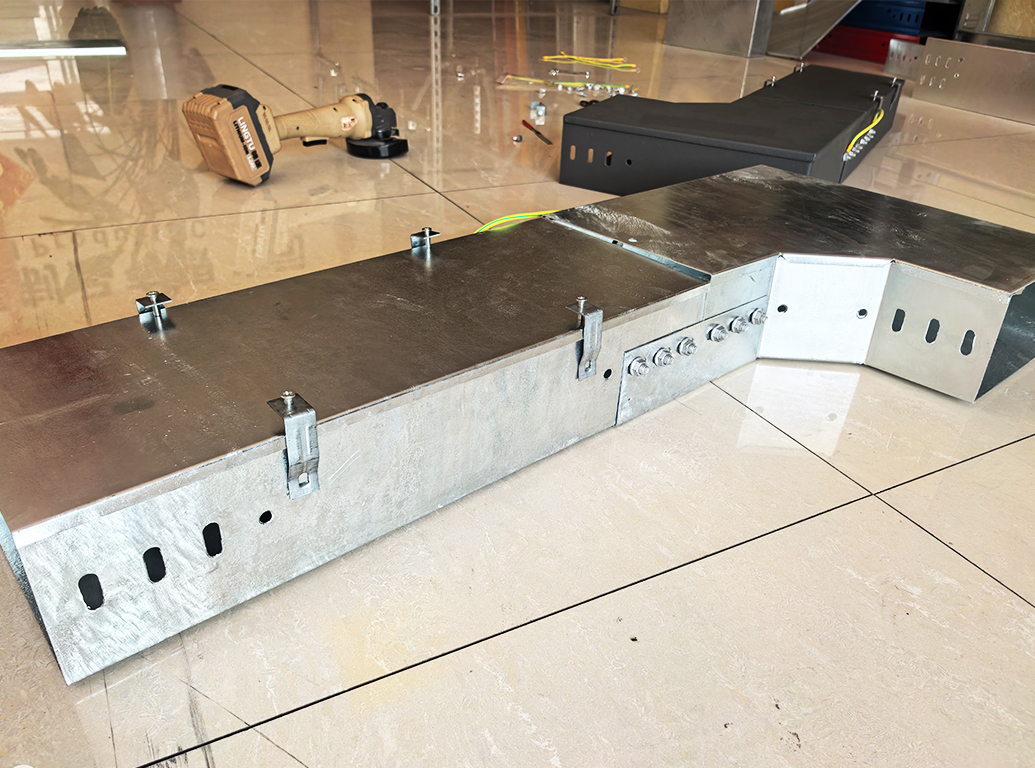
Large span cable trays are a critical part of modern cable management systems in industrial plants, data centers, power stations, commercial buildings, tunnels, airports, and infrastructure projects. As cable density increases and routing distances become longer, the demand for stable, durable, and high-capacity cable support systems continues to grow. Among the many product categories in the cable tray industry, large span cable trays stand out because they are designed to bridge wider distances with fewer supports, while still maintaining load-bearing performance, safety, and installation efficiency.
This page provides a detailed, SEO-friendly overview of the difficulties and solutions in the production of large span cable trays. It is written for industry pages, blog content, directory pages, and technical landing pages. The content is focused on general industry knowledge, not any specific company recommendation. It includes definitions, benefits, production challenges, solution methods, material comparisons, specification tables, and application scenarios. If you are researching large span cable trays, heavy duty cable tray systems, industrial cable management, or Custom cable tray fabrication, this content can help improve user understanding and support SEO visibility.
A large span cable tray is a cable support structure engineered to cover longer distances between support points than Standard cable trays. In many projects, conventional trays require frequent support brackets or hangers. By contrast, large span cable trays are designed for wider spans, allowing installers to reduce the number of support points while maintaining rigidity, load capacity, and cable protection.
Large span cable trays are commonly used when project conditions demand:
These systems are often fabricated from galvanized steel, stainless steel, aluminum, or other metal materials depending on the installation environment, corrosion exposure, structural requirements, and budget.
In modern engineering projects, cable management is no longer just about holding wires in place. It directly affects safety, maintenance efficiency, system reliability, and long-term operating costs. Large span cable trays offer several advantages compared with shorter-span alternatives:
For this reason, the market for large span cable trays continues to expand in manufacturing, utilities, transportation, energy, and data infrastructure sectors.
The choice of raw material is one of the most important factors in large span cable tray fabrication. Each material offers different advantages in terms of strength, corrosion resistance, weight, and cost.
| Material | Main Advantages | Typical Applications | Key Considerations |
|---|---|---|---|
| Hot-dip galvanized steel | Strong, durable, cost-effective, good corrosion resistance | Industrial plants, outdoor routes, utility projects | Heavier than aluminum; coating quality must be controlled |
| Pre-galvanized steel | Affordable, easy to process, widely available | Indoor commercial and light industrial environments | Less resistant than hot-dip galvanizing in harsh environments |
| Stainless steel | Excellent corrosion resistance, long service life, high hygiene level | Food processing, marine, chemical, offshore, clean rooms | Higher material cost and fabrication difficulty |
| Aluminum | Lightweight, corrosion-resistant, easy handling | Data centers, indoor infrastructure, projects needing low dead weight | Lower stiffness than steel in some designs; pricing varies |
| Powder-coated steel | Good appearance, color options, additional protection | Commercial interiors, exposed architectural installations | Coating adhesion and surface preparation are critical |
Large span cable tray systems are manufactured in several structural forms. The best choice depends on cable weight, installation environment, and required span.
| Tray Type | Structure | Advantages | Common Use Cases |
|---|---|---|---|
| Perforated cable tray | Solid side rails with perforated bottom | Light ventilation, moderate support, easy cable fixing | General industrial cable routing |
| Ladder cable tray | Side rails with rungs | Excellent ventilation, strong load capacity, suitable for longer spans | Heavy cable bundles, power distribution |
| Solid bottom tray | Continuous base structure | Better protection against dust and small debris | Indoor applications, sensitive cable systems |
| Trough tray | Shallow channel form | Balanced support and cost efficiency | Medium-load routing systems |
| Custom large span tray | Engineered according to project dimensions | Tailored strength, span, and coating options | Special infrastructure and heavy-duty systems |
Producing large span cable trays is more complex than manufacturing standard trays. Because the system must bridge greater distances with fewer supports, every aspect of design and fabrication becomes more demanding. Below are the most common production difficulties in the large span cable tray industry.
The biggest challenge in large span cable tray production is ensuring that the tray remains stable and does not deform under load. When the span increases, bending stress rises sharply. If the design is not optimized, the tray may sag, twist, or lose alignment after installation.
This challenge becomes more serious when the tray carries:
Deflection control is essential for large span cable trays. Excessive sagging can create cable stress, reduce safety, and lead to poor visual alignment. In projects where tray appearance and structural reliability matter, controlling deflection is a major engineering requirement.
If a tray is made too heavy, installation becomes more difficult and support structures must be stronger. If it is made too light, load capacity may be insufficient. The production process must balance material thickness, structural reinforcement, and dead weight.
Large span cable trays often require highly accurate cutting, welding, bending, punching, and assembly. Even small fabrication errors can affect fit-up, straightness, and connection stability across long distances.
Large span cable trays are often installed in demanding environments such as outdoor facilities, tunnels, power plants, and marine-related areas. The surface treatment must provide lasting corrosion protection without reducing dimensional accuracy or connection quality.
Large span trays are often longer, wider, or heavier than standard tray products. This creates packaging, transport, and handling challenges. Products must be protected from bending, scratching, coating damage, and deformation during shipping.
Different markets and projects may require different standards for dimensions, load testing, coating thickness, fire performance, and quality inspection. Production systems need to adapt to varied technical requirements while still maintaining consistency.
Large span cable trays require more careful material use, stronger quality control, and often more complex manufacturing steps. Controlling production cost while preserving durability and safety is a constant challenge.
Although the difficulties are significant, modern fabrication methods and engineering practices offer effective solutions. Manufacturers and project planners can improve product performance by addressing each issue systematically.
Before production, tray geometry should be evaluated through engineering design and structural simulation. Load analysis helps determine the best tray profile, thickness, reinforcement positions, and span limits. Finite element analysis and load testing can reduce the risk of failure.
To improve load-bearing capability, manufacturers can use reinforced side rails, bottom stiffeners, ribbed structures, or thicker gauge materials in critical sections. Reinforcement is especially useful for long-span installations with high cable density.
Material choice should match the environment and expected cable load. For example, hot-dip galvanized steel is often suitable for strong and economical applications, while stainless steel may be better for corrosive or hygiene-sensitive environments. Using the right material improves service life and reduces maintenance cost.
Accurate metal cutting, bending, punching, rolling, and welding are essential. CNC-controlled equipment improves repeatability and reduces dimensional deviation. Consistent production helps ensure that long tray sections align properly during installation.
The chosen coating process should protect the tray from corrosion and environmental wear. Common solutions include:
Modular tray sections can simplify transport and installation. Standardized connectors, splice plates, and accessories reduce field errors and improve assembly efficiency. Modular design also helps with future maintenance and expansion.
Quality control should include checks for dimensional accuracy, coating thickness, welding integrity, load performance, and surface smoothness. Inspection at every stage of production helps reduce defects and ensures consistent product reliability.
To prevent damage during transport, trays should be packed with protective padding, corner protection, and stable stacking methods. For long-span products, proper shipping design is necessary to avoid bending and coating damage before installation.
Although exact workflows may vary, most large span cable tray production lines follow a similar sequence. Understanding this process can help buyers and engineers evaluate product quality more effectively.
| Production Stage | Main Purpose | Quality Focus |
|---|---|---|
| Material preparation | Select and cut raw metal sheets or profiles | Material grade, thickness, surface condition |
| Forming | Shape tray side rails, bottom sections, and support elements | Dimensional accuracy, symmetry, straightness |
| Perforation or slotting | Create holes or openings for cable fixing and ventilation | Hole precision, edge smoothness, consistency |
| Welding or assembly | Join components into finished tray sections | Joint strength, alignment, deformation control |
| Surface treatment | Apply anti-corrosion protection or coating | Coating thickness, adhesion, coverage |
| Inspection | Check quality before packaging | Load capacity, appearance, dimensions, coating integrity |
| Packaging and shipment | Protect products during transport | Anti-bending protection, stack stability, labeling |
The exact specifications of large span cable trays depend on project requirements, but the table below shows common ranges used in the industry. These values are general reference information only.
| Specification Item | Typical Range | Notes |
|---|---|---|
| Tray width | 100 mm to 1000 mm | Wider widths are used for larger cable volumes |
| Tray depth | 50 mm to 200 mm | Deeper trays usually improve cable support and capacity |
| Span length | 3 m to 12 m or more | Depends on structural design and load requirement |
| Material thickness | 1.5 mm to 6.0 mm | Heavier loads generally require thicker material |
| Surface finish | Galvanized, powder coated, stainless steel | Selected based on environment and budget |
| Load rating | Light, medium, heavy duty | Must be verified by engineering and testing |
| Accessories | Splice plates, covers, clamps, brackets | Accessory compatibility is important for installation |
Large span cable trays are widely chosen because they provide a practical balance between structural strength and installation efficiency. The main advantages include:
In projects where uptime, reliability, and future expansion are critical, a large span cable tray system can offer a more flexible solution than frequent-support tray systems.
Large span cable trays are used in a wide range of industries and building types. Their versatility makes them valuable in both new construction and retrofit projects.
| Application Area | Why Large Span Cable Trays Are Suitable |
|---|---|
| Data centers | Need organized cable routing, easy maintenance, and expansion support |
| Power plants | Require durable support for heavy electrical and control cables |
| Manufacturing facilities | Need overhead cable routes with minimal interference to operations |
| Commercial complexes | Benefit from clean routing and accessible maintenance paths |
| Transportation infrastructure | Useful in tunnels, airports, stations, and bridges |
| Oil and gas facilities | May require corrosion-resistant and heavy-duty tray systems |
| Marine environments | Need strong anti-corrosion performance and durable mounting |
Buyers and engineers evaluating large span cable tray products should pay attention to the following quality factors:
From an SEO perspective, content about large span cable trays performs well when it includes clear definitions, technical terms, practical applications, and specification details. Search engines tend to favor content that answers user intent comprehensively. Pages that discuss large span cable tray production difficulties, cable tray solutions, heavy duty cable management, and Industrial cable tray specifications can attract both technical and commercial traffic.
Important keyword themes for this subject include:
| Question | General Answer |
|---|---|
| What makes large span cable trays different from standard trays? | They are engineered to bridge wider distances between supports while carrying heavier loads. |
| Which material is best for outdoor large span trays? | Hot-dip galvanized steel and stainless steel are commonly used for outdoor corrosion resistance. |
| Why is deflection important? | Too much deflection can damage cables, reduce safety, and affect installation quality. |
| Can large span cable trays be customized? | Yes. Width, depth, span, material, and coating can often be tailored to project needs. |
| Are large span trays suitable for heavy cable bundles? | Yes, provided the structural design and load rating are properly engineered and verified. |
Large span cable trays are an essential solution for modern cable support systems where wide distances, heavy cable loads, and installation efficiency are important. However, the production of large span cable trays involves several technical challenges, including structural strength, deflection control, material selection, fabrication accuracy, corrosion resistance, and logistics management.
The most effective solutions include engineering simulation, reinforced design, precision fabrication, correct material choice, advanced surface treatment, modular assembly, and strong quality control. When these factors are properly managed, large span cable trays can deliver excellent durability, stable load performance, and long service life in demanding industrial environments.
For companies, contractors, and project planners, understanding the difficulties and solutions in large span cable tray production is critical to choosing the right system and achieving safe, efficient, and maintainable cable management.


Copyright © 2026 Hebei Xinnin Metal Products Co., Ltd
แผนผังไซต์เว็บไซต์นี้ใช้คุกกี้เพื่อให้แน่ใจว่าคุณได้รับประสบการณ์ที่ดีที่สุดบนเว็บไซต์ของเรา
 English
 Español
 한국어
한국어 العربية



 โทรศัพท์
ความคิดเห็น
(0)